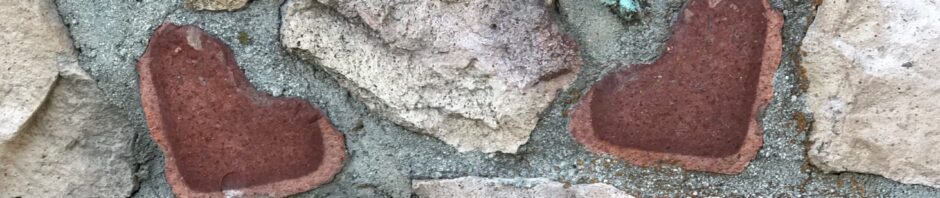
Just when we thought we had seen all the beautiful stone houses built by the area’s Native American stonemasons at Lake Tahoe, we found one more!

This one is on Park Avenue in South Lake Tahoe, California, and dates to 1954. According to Wungnema family history, members of the Wungnema family were involved in the stonework at the house.
And when we look at the fireplace, it is easy to understand why the family connection is so intriguing, so strong.
The fireplace contains a number of features reminiscent of stonework known to have been created by Ernest Wungnema and his sons.
The Wungnemas frequently worked collaboratively on residential projects, making it possible that more than one member of the family participated in creating the stonework at this remarkable lakeside property.
At this point, however, we have not located documentary evidence identifying the individual mason or masons. The Wungnema attribution comes from family history and should be considered alongside the physical evidence provided by the stonework itself.


The house is approximately 2,077 square feet and sits on roughly one-quarter acre of lakefront property. Located near the corner of Park Avenue and Lakeshore Boulevard, adjacent to Lakeside Marina, it occupies a prime piece of South Lake Tahoe shoreline.
And, beyond the stonework, the house has an interesting history.


The Lake Tahoe Historical Society’s Lakeside Park History Trail (Society) identifies this historic residence as the “Nick Sahati house.” According to the Society, Sahati reportedly rented the house to Bill Harrah before Harrah built his own residence at Skyland. The Society also reports that numerous entertainers, including Cher and Phyllis Diller, stayed at the property and enjoyed access to its beach.
That brings us to an interesting question:
We know you’re asking – Who was Nick Sahati, and what was he doing at Lake Tahoe when this house was built in 1954? Good question!
Nick Sahati and his brother, Eddie, acquired the State Line Country Club in the mid-1940s. When Eddie died in 1952, Nick continued his involvement with the property throughout the 1950s. In 1958, Sahati sold the State Line Country Club to Bill Harrah.

And this is where our stonework story becomes particularly interesting.
In 1933, then-owner Nick Abelman and his partners reportedly spent approximately $48,000 expanding the State Line Country Club. The improvements included a large hardwood dance floor and an enormous fireplace.
Tahoe historian Mark McLaughlin has described the Country Club as having a “massive stone fireplace.”
The fireplace was already there when the Sahati brothers acquired the club in 1946. For years, therefore, Nick Sahati would have been intimately familiar with this impressive piece of Tahoe stonework.

The fireplace itself is especially interesting to us because its massive irregular stone construction is consistent with the broader rustic masonry tradition seen around Lake Tahoe during the period when Stewart Indian School-trained Native American stonemasons were actively working throughout the region.
That observation, however, is not an attribution. We have not yet found documentation identifying the mason(s) who constructed the State Line Country Club fireplace.
Did One Fireplace Inspire Another? That question brings us back to the Park Avenue house.
Could the massive stone fireplace at the State Line Country Club have influenced Nick Sahati when his lakeside residence was constructed?
It is certainly possible.
The Park Avenue property features substantial stonework, and its fireplace shares characteristics with the rustic masonry Sahati would have known from the Country Club. Perhaps Sahati simply liked the appearance of the Country Club fireplace and wanted something similar in his own home.
There is another possibility worth investigating.
Could Sahati have hired a mason—or a masonry crew—working in the same Tahoe stone working tradition?
At present, we cannot say.
There is no evidence yet showing that the same stonemason constructed both fireplaces. In fact, the Country Club fireplace predates the Park Avenue house by approximately two decades. What we do have is an intriguing architectural connection worthy of further research.
Hopefully, building permits, assessor records, family papers, newspaper accounts or other historical documents will eventually identify the craftspeople responsible for these remarkable pieces of masonry.
Another avenue of research would be to compare detailed photographs of the Park Avenue fireplace with documented Wungnema stonework. Rather than relying simply on an overall resemblance, the comparison should examine specific masonry characteristics, including joint style, stone selection, coursing, keystone and lintel treatment, corners, hearth construction, and the way individual stones were shaped and fitted.
Those details may help us better understand who created the fireplace—or at least the masonry tradition from which it came.
What Happened to the State Line Country Club? We knew you were going to ask!
Sadly, the State Line Country Club did not survive.
Its history can be summarized in a short timeline:
* 1931–1933: The State Line Country Club emerged as one of the important early casinos on Tahoe’s South Shore. A major expansion in 1933 included its impressive stone fireplace and a large hardwood dance floor.
* 1945–1946: Brothers Nick and Eddie Sahati acquired the Country Club from Nick Abelman and his partners for approximately $350,000. Under the Sahatis, it became an important dining, gambling and entertainment destination.
* 1952: Eddie Sahati died. Nick subsequently leased the Country Club and neighboring properties to other operators.
* 1954: The Park Avenue house associated with Nick Sahati was constructed.
* 1955–1958: Bill Harrah began acquiring properties around Stateline as he planned a much larger casino operation.
* 1958: Nick Sahati sold the State Line Country Club to Bill Harrah for approximately $350,000. For perspective, $350,000 in 1958 represents roughly $4 million in today’s purchasing power.
* 1959: The old State Line Country Club was demolished as Harrah redeveloped and consolidated the properties that would become part of the expanding Harrah’s Tahoe complex.
And the fireplace, what happened to the fireplace?
That is the question – What happened to that magnificent stone fireplace?
As far as we have been able to determine, it disappeared with the State Line Country Club when the building was demolished in 1959.
The old fireplace was not incorporated into the Harrah’s building we know today. Harrah was assembling and redeveloping several adjoining properties, including the State Line Country Club and the Nevada Club, to create a much larger casino and entertainment complex.
Unless evidence eventually surfaces showing that some of the stone was salvaged, we have to assume that this remarkable example of early Tahoe masonry was lost to history.
Fortunately, photographs survive.
Those photographs allow us to study the fireplace today—and provide another piece of evidence documenting the remarkable tradition of stone construction that once characterized so much of the Lake Tahoe region.

And just because we could, we had one of those historic photographs colorized

Both the fireplace and the house on Park Avenue are important pieces of the history and traditions of the Native American stonemasons who worked throughout Northern Nevada and Northern California. Their craftsmanship helped shape the distinctive character of Lake Tahoe, leaving behind stonework that continues to tell their story generations later. Their work contributed to the economy of both states.
Their story also intersects with another important chapter in Lake Tahoe history—the birth and growth of the casino industry. These stonemasons were working in the Tahoe Basin as the region began its transformation into a nationally known resort and gaming destination. Their work became part of the homes, lodges, fireplaces, walls, and other structures that defined this remarkable period in Tahoe’s development.
The Park Avenue house and its fireplace are therefore more than beautiful examples of stonework. They are tangible reminders of the Native American craftsmen whose skills, traditions, and artistry became woven into the architectural and cultural history of Lake Tahoe.