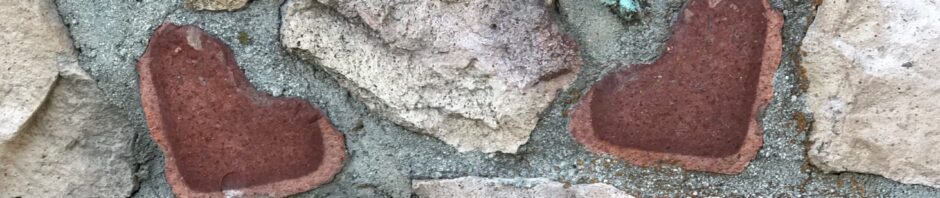
There is a beach on the east shore of Lake Tahoe, a wonderful beach. This beach started off life with no name, became Elephant Beach and morphed into Chimney Beach. And, yes, this beach has a fascinating history directly connected to Nevada’s Native American stonemasons.
This beach has an intriguing background, so interesting, we could not make it up! The beach was part of George Whittle’s extensive property holdings at Lake Tahoe. Whittel (1881–1969) is one of the most colorful and remarkable figures in both Nevada and Lake Tahoe history. Sometimes, it’s difficult to separate fact from fiction where the stories of his life are concerned. He built the Thunderbird Lodge (Lodge) at Lake Tahoe using the best craftsman, including the area’s Native American stonemasons.
The man was beyond wealthy, eccentric, intensely private, adventurous, fond of exotic animals (he had his own zoo at Lake Tahoe). There are stories about him driving around Lake Tahoe in a convertible, top down, with a lion riding shotgun.
Whittel had a need for privacy. This need, plus his desire to own as much land as possible, helped keep Lake Tahoe’s east shore from being developed.
One of Whitell’s properties is a beach, now called Chimney Beach, where he had a small house built for the caretaker of the Lodge. The story of the house is interesting. The house was called the Caretaker’s Cottage (Cottage) and featured a stone fireplace, which was used for heatng during those long Tahoe winters.

We believe that the same Native American stonemasons who built the Lodge, built the fireplace. We believe this as Whittel employed Native American stone masons when building the Lodge and as the Cottage was part of the Lodge, it’s logical to presume those craftsman also build the fireplace at the Cottage.
If we look at the fireplace, we see the same attention to detail that is present in other fireplaces built by the Native American stonemasons. We see the precise placement of the stones, the careful pointing of the mortar. All these details plus the documented work of the Native American stonemasons at the Lodge, support our conclusion that the fireplace is another masterpiece of these talented masons.
The National Register documentation specifically describes the Whittell Estate (Lodge) as exhibiting a high level of stone-masonry craftsmanship which is also evident in the fireplace at Chimney Beach.
Whittel gave the Native American stonemasons working on the Lodge creative freedom. He’d met with them in the morning, gave them an idea of what he wanted and then gave them free rein to make those ideas a reality. While the fireplace is not as elaborate as the Lodge, we think those same stonemasons had identical creative freedom in its construction.
Originally, the beach was called Elephant Beach in honor of Mingo, an Asian elephant owned by Whittel, who had a private zoo on the grounds of the Lodge, where Mingo lived in a dedicated elephant house.
Mingo was frequently walked along the shores of the Lake to the Cottage. The reason being, there was a secluded, sandy cove in front of the Cottage making it perfect for Mingo to swim and excise. Plus, he could drink his fill of the cold, clean lake water.
Seeing Mingo on the beach provided stories for both the locals and boaters who started using the name Elephant Beach. However, the name changed in the 1980s. The name change began in 1969 when Whittel died.
During Whitell’s lifetime, all of his extensive properties were privately held; these properties included the Lodge and the Cottage at Elephant Beach/Chimney Beach. However, after his death, his estate (including the Tahoe properties) was sold off. The property on Lake Tahoe’s eastern shoreline was acquired by the U.S. Forest Service (USFS) and Nevada State Parks (Parks).
Once the property became public, nobody lived in the Cottage, nobody maintained or loved the Cottage. Because of the neglect, the Cottage became a severe, demonstrated, safety hazard. The deterioration of the Cottage led to a decision, sometime in the 1980s, to demolish the Cottage.
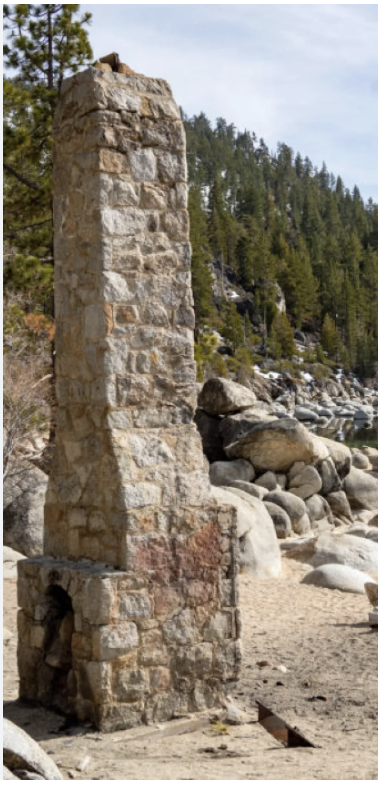
The USFS destroyed the Cottage in a controlled burn using standard, safety demolition practices. However, the USFS looked to the future and did not totally destroy the Cottage. Instead, the Cottage’s fireplace was deliberately left standing as a monument to the bygone days of Lake Tahoe’s historic era.
We need to thank the USFS for saving a vital part of the Lake’s history, for preserving the work of our Native American stonemasons. This preservation means, we have a real-life example of their work to admire instead of relying on photographs.
Look at photographs of the fireplace – 100 years on and the mortar is still intact, the stones remain in place, a testament to the “high level” craftsmanship for which the Native Americans are known for.
What happened to Mingo? (We knew you’d ask).
There were many, many rumors that Mingo drowned in Lake Tahoe, while swimming, when the seaplane he was riding in crashed into Lake Tahoe or when he fell off a barge into the Lake and that he is perfectly preserved at the bottom of the Lake. These stories are far from true.

When Whittel was in his 70s, one of his pet lions fell on him and broke his leg. He refused surgery and became wheelchair bound. Because of his disability, he began spending less time at Tahoe and more time at his home in Woodside, California. Mingo moved to Woodside with Whittel and spent the rest of his days there. It is thought that Mingo died of natural causes prior to Whittle’s death.