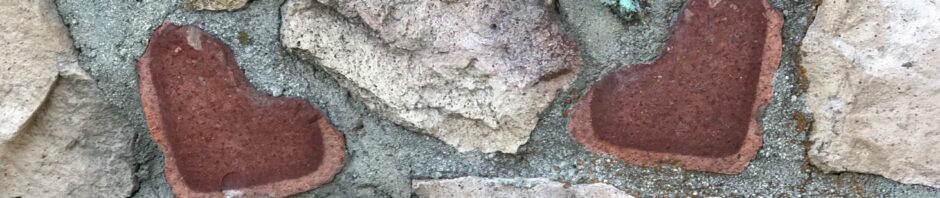
Guess what we found!
Stone pillars! Stone walls! And, quite possibly, another example of the beautiful craftsmanship of Northern Nevada’s Native American stonemasons!
These marvelous creations are located at the top of Lakeview Hill, just off Old Highway 395, between Carson City and Reno.
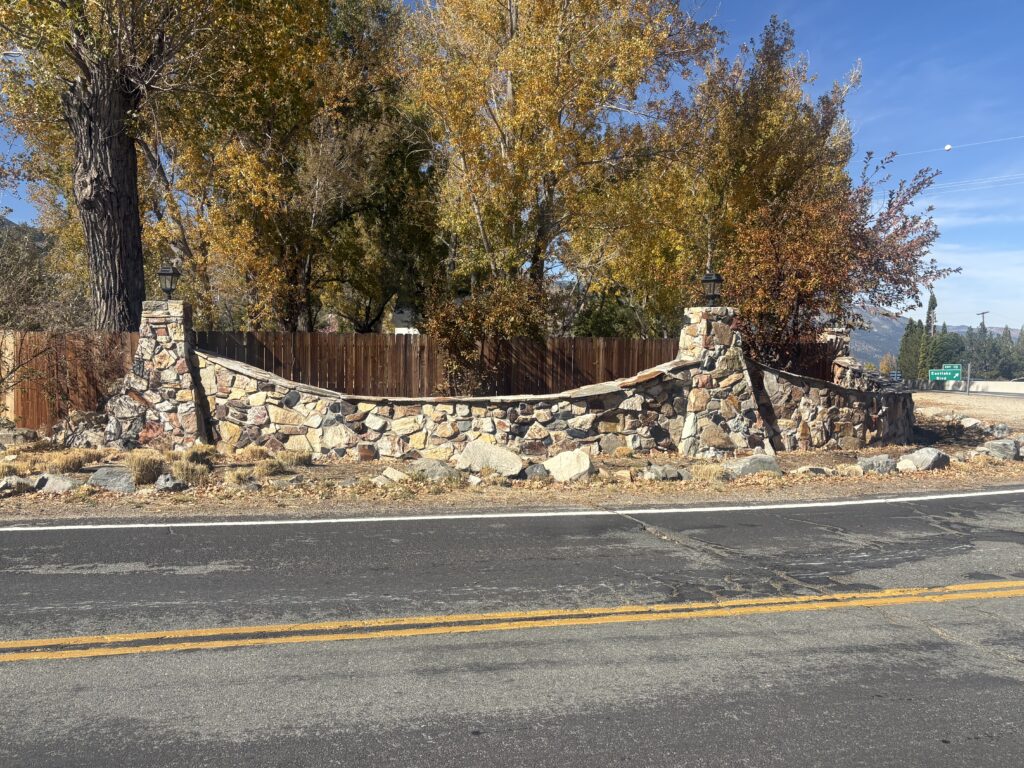
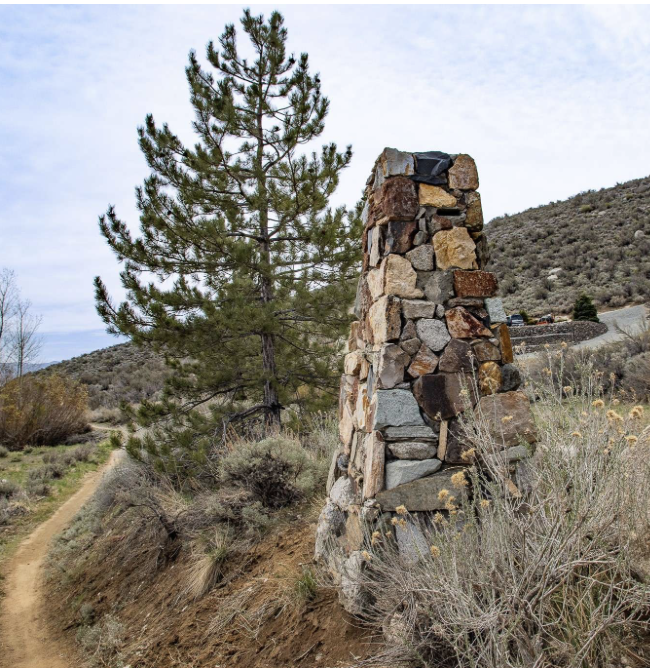
Now, here’s the embarrassing part. We’ve driven past these structures thousands of times (more or less), while traveling to Reno and back, and only recently noticed them.
Thousands of times, folks. Apparently, we need to spend a little less time watching the road and a little more time admiring the scenery. Although, come to think of it, watching the road is probably a good idea.
The stonework consists of two walls, one on either side of the entrance to Lakeview, and approximately four freestanding stone pillars extending southward from one of the walls. The arrangement suggests that the pillars may once have supported fencing or served as decorative boundary markers.
The stonework is believed to have been constructed around 1965, possibly as a nod to Lakeview’s historical significance and its contributions to the development of Carson City.
And what a history Lakeview has!
As we began researching the stonework, we discovered that Lakeview was once a bustling little community. At various times, it supported two inns, a post office, and a depot for the Virginia & Truckee Railroad. It was also an important location for the Virginia City and Gold Hill Water Company, which maintained a superintendent’s residence there.
The road through Lakeview provides access to Marlette Lake and Hobart Reservoir, both important to the region’s historic water systems. Lakeview was once a crossroads of transportation, commerce, and water development.
Eventually, changing transportation routes, the decline of railroad operations, and the construction of modern highways diminished Lakeview’s importance as a commercial center. The inns, post office, and railroad facilities disappeared, leaving behind reminders of a once-busy community.
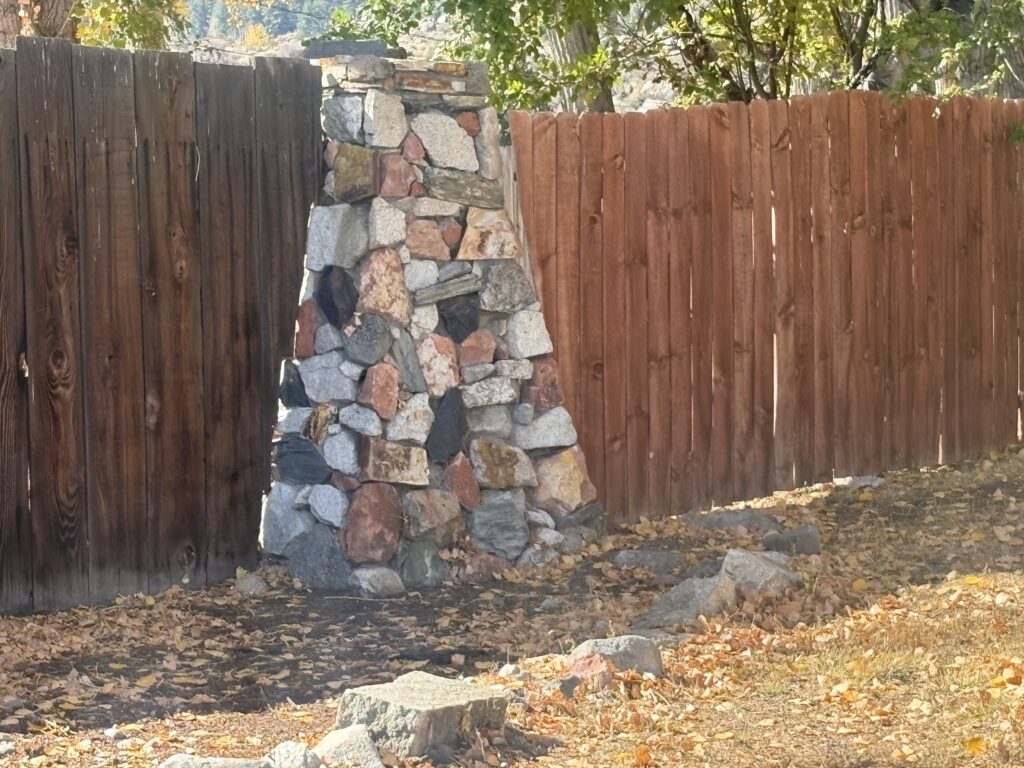
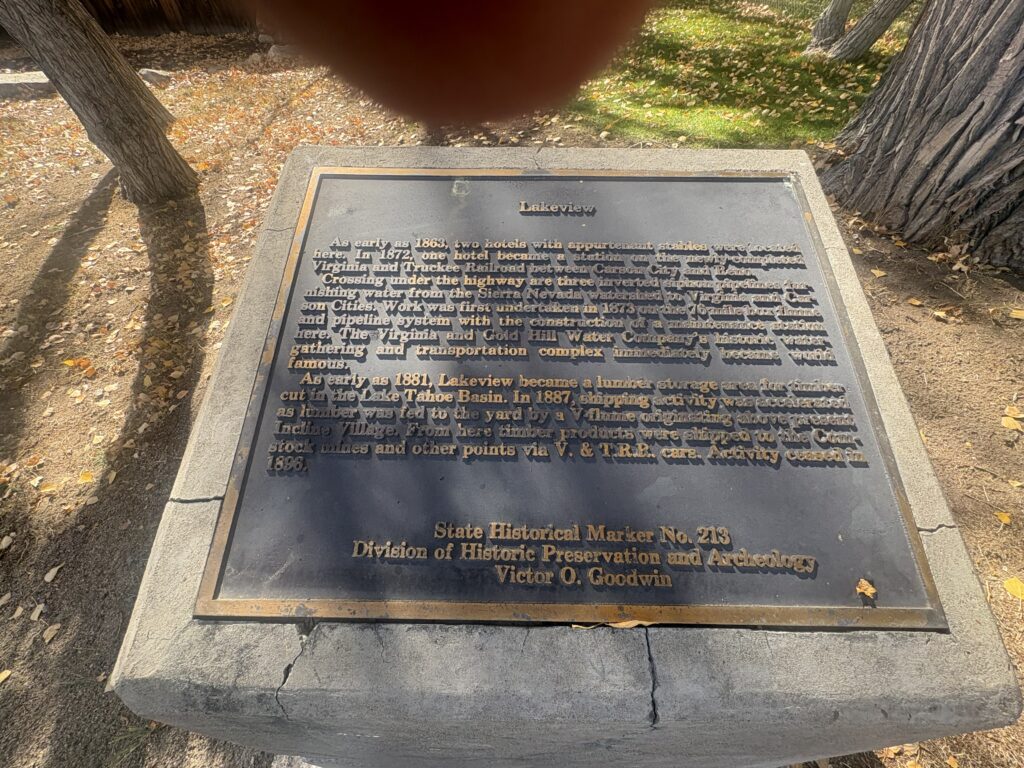
And perhaps that is why someone decided, around 1965, to commemorate Lakeview with these handsome stone walls and pillars.
But who built them?
Ah, now there’s the question!
Taking a closer look at the structures, we noticed variations in the stone selection, placement, and overall construction techniques. These differences suggest that more than one stonemason may have worked on the project.
And, naturally, that got us thinking about the Native American stonemasons who worked throughout Northern Nevada and the Lake Tahoe Basin.
Could these walls and pillars be their handiwork?
We certainly think it’s possible.
The use of native stone, the irregular shapes, and the careful placement of individual rocks are all characteristics we have observed in other structures associated with these talented craftsmen.
Unfortunately, similarities in construction techniques do not constitute proof. And proof, as we have discovered time and again, can be remarkably difficult to find.
Building permits, assuming they still exist, generally identify property owners and contractors rather than the individual craftsmen who actually performed the work. Consequently, even if we locate the original permit, it may not tell us who selected, shaped, and placed these stones.
Then there’s the Stewart Indian School (Stewart).
Many of Northern Nevada’s Native American stonemasons learned or refined their skills at Stewart, where masonry was an important vocational trade. Records from the school could potentially help identify the craftsmen working in the region during the period when the Lakeview structures were built.
Unfortunately, researching those records presents challenges of its own.
A substantial collection of Stewart Indian School records was transferred to the National Archives in San Bruno, California. We have heard accounts suggesting that some of the paperwork was packed into boxes without much organization before being shipped off for storage.
Whether those accounts accurately describe the handling and cataloging of the records remains to be determined. What we do know is that locating a particular document among decades of school records can be a daunting undertaking.
And what a shame it would be if valuable information about the school, its students, and the remarkable work they accomplished remained buried in boxes, waiting for someone to rediscover it.
After all, these records aren’t simply old paperwork. They are pieces of history, potentially containing the names, accomplishments, and stories of people whose contributions to Northern Nevada deserve to be remembered.
But back to Lakeview.
There’s a small parking area near the stonework, and from there, a trail appears to connect with the Virginia & Truckee Railroad Trail overlooking the Silver Oak residential development.
One of these days, we’ll have to put on our walking shoes, follow that trail, and see where it takes us.
Who knows? Perhaps we’ll discover another forgotten stone structure, an old railroad feature, or something else that sends us down yet another historical rabbit hole.
We’ve certainly been down a few of those lately.
And So, the Mystery Continues…
For now, we have two beautiful stone walls, four freestanding pillars, an estimated construction date of 1965, and a strong suspicion that Native American stonemasons may have been responsible for their creation.
What we don’t have is a name. A name of the stonemason.
Or names.
And that, of course, is the frustrating part of researching these remarkable craftsmen. Their work is everywhere, often standing in plain sight for generations, while the identities of the men – and women – who created it have quietly slipped from the historical record.
We can admire their craftsmanship, study their techniques, and make educated guesses. But until we uncover a photograph, a construction record, or perhaps a family recollection identifying the builders, these structures will remain another tantalizing mystery.
Were they built by Native American stonemasons? Definitely possible.
Were they built by members of the Wungnema family or another Stewart-trained craftsman? Maybe.
Can we prove it? Not yet.
And there you have it.
A definite, possible maybe.
But we’re not giving up. After all, these stone walls and pillars have been standing for approximately 60 years, patiently waiting for someone to tell their story.
What’s a little more waiting?